Introducing the Grand Canal and the Royal Canal
Mentions of Dublin’s Canals, both the Royal and the Grand, pour aplenty through Irish poetry and song. On each canal, you’ll even find a poet’s statue.
The Royal Canal has Brendan Behan, turned to look at you if you sit beside him. While, true to character, Patrick Kavanagh is on the Grand Canal, arms crossed and pensive as he watches the passing water.
To each canal, they dedicated lyrics: the passionate ‘Auld Triangle’ for the Royal and the contemplative ‘Canal Bank Walk’ for the Grand.
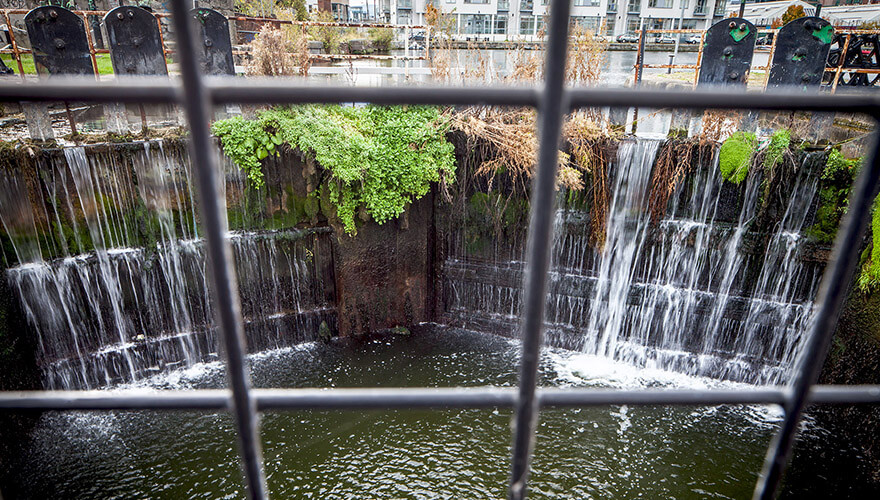
Image courtesy of Paul McGuckin Photography
Dublin’s canals run through the heart of Dublin like arteries before unfurling into the countryside. The Grand braces the city on the southside, stretching west 144km to the Shannon river. And The Royal, on the northside, winds 146km to the same river.
Despite their romantic depiction in poem and song, as well as their leisurely uses, Dublin’s canals are often overlooked.
You might well sit on a bench along the canal with your sandwiches, perhaps watching a heron stand tall in the water, and forget that there was a time when the water here was far from “stilly” and “greeny”. These passages were once part of a vital distribution network for, amongst other items, large wooden casks of Guinness.
Two histories intertwined
In the Guinness Storehouse, we sat down with archivist Eibhlin Colgan. Over the buzz of the tours downstairs, she told us how the history of the Grand Canal is bound up in that of the James’s Gate brewery.
“The brewery was founded here in 1759. However, just two years previously, work had begun on the Grand Canal right here at James’s Street,” she explains. “So the growing up of the Grand Canal from the Dublin end and the brewery very much coincided,” she explains.
Guinness would have been one of the very last goods transported by canal.
The Guinness brewery used the canal as a distribution network right up until 1960. Barges provided transport for both ends of its process – for raw materials and the product itself.
“So from the farmers and the malting companies down the country, you’d have big sacks of malt put on the canal barges and brought up to the James’s Street harbour,” Eibhlin says.
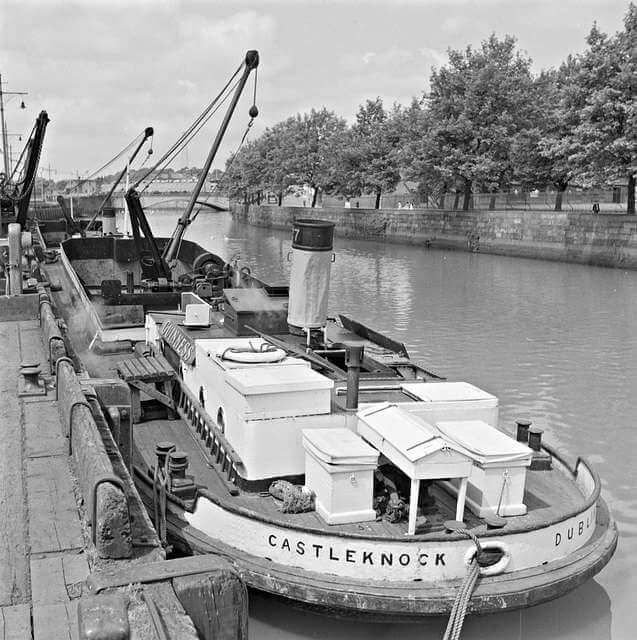
The ‘Castleknock’ Guinness Barge, 1959. Source: National Library of Ireland
The old harbour basin has long since been concreted in, but once there was a spur that went from James’s Street canal basin right into the actual brewery itself.
“It was bringing grains from the country right up to the back door of the brewery,” Eibhlin says.
“Guinness would have been one of the very last goods transported by canal. Certainly in terms of volume, they would’ve been the biggest canal customer.”
Future plans for Dublin’s canals
And what about the future of the two canals? We spoke to John Boyle at Waterways Ireland to find out more. And he tells us that there is a raft of new proposals for making the most of the canals and their basins in the future.
Grand plans for Grand Canal Dock
One proposal is for a floating garden that would provide a haven for the wildlife at Grand Canal Dock. And another is for a boardwalk to connect the train station with its outer dock.
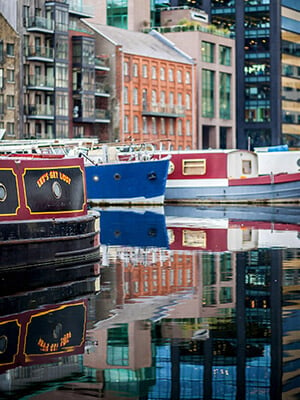
Image courtesy of Paul McGuckin Photography
With the input of other stakeholders, Waterways Ireland is currently working on its plans for the next decade and beyond.
However, all that is certain for now is there will be some sort of infrastructure for wildlife and a boardwalk to make the water more accessible.
However, it is clear that the dock, which opened in 1796, is at the heart of plans for the two Dublin canals.
In recent years, houseboats received permission to moor there. This has brought more footfall and is just the first of many plans to liven up the area.
“We’d like to see a place of life: total animation, day and night, all year round,” John says. “The size of it, the scale of it is unique in Europe. It’s one of the best waterways in Europe in a city centre location.”
A water sports hub
He’d also like to see Dublin’s Grand Canal Dock become the water playground of Dublin.
“If we get the water quality up,” he says, “we’ll look to attract international triathlons, open-water swimming and major, multinational events that would attract thousands.”
We’d like to see a place of life: total animation, day and night, all year round.
Waterways Ireland says issues with water quality at Grand Canal Dock only occur after heavy rainfall.
However, a joint project by Dublin City Council and Irish Water to address this is currently underway. This will allow activities and events to be planned without fear that stormy weather will result in cancellation.
This could form a path forward for the vision John describes.