Last year, I wrote about an eighteen-year-old founder building an AI retail business and a 150-year-old Dublin hardware shop using AI to help customers. They showed that innovation could come from almost anywhere.
The 2026 AI Awards submissions tell the next part of that story. More than 275 applications have come in from across Ireland. They are not a census of Irish businesses, and judging is still under way. But they provide a valuable window into how organisations are putting AI to work.
The shift is clear: more teams are moving beyond a chatbot demonstration. They are using AI inside the work that customers, employees and communities depend on.

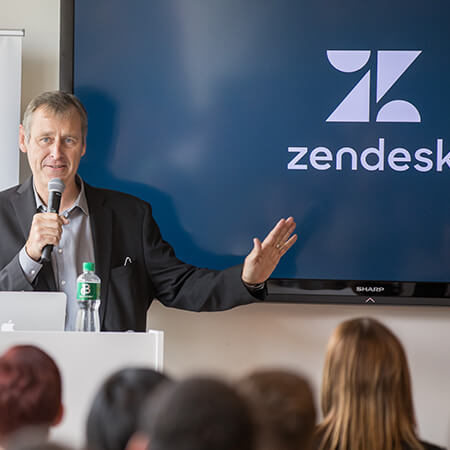
Mark Kelly Captures a Photo with the AI Awards Audience
The practical work comes first
Consider the time spent reading documents, preparing reports and finding the right information. In this year’s submissions, we see AI helping teams analyse clinical research feedback, prepare inspection reports and shorten regulatory assessments. The human specialist still checks the result and makes the decision. AI helps them get to that point faster.
That is a meaningful change for a small business or a public service as much as it is for a large company. A shorter process can mean a quicker response to a customer, more time for professional judgement or a service that can reach more people.
The same principle appears in marketing and creative work. One application described a substantial reduction in the cost of producing creative assets at scale. The opportunity is not simply to produce more material. It is to free a team to test ideas, learn what works and spend more time understanding its audience.
These are claims made by applicants about their own projects. They are promising examples, not independently verified results for every organisation.
From saving time to creating value
There is another change in the 2026 entries. Some organisations are beginning to ask what they can offer customers because AI now exists.
One submission describes bringing AI readiness, security, governance and deployment together as a service. Another describes a more personalised insurance buying journey. An energy provider describes using AI to give households more relevant advice. The sectors differ, but the business question is the same: how can we make an existing service easier to use, or create a useful new one?
This matters for Dublin. Our AI landscape includes global technology firms and startups, but it also includes professional services, healthcare, financial services, retailers and public bodies. Their advantage often lies in understanding a specific customer problem and having the expertise and data to address it responsibly.
Sustainability is becoming a practical AI challenge
The Best Application of AI in Sustainability category shows the breadth of that work. One farming entry makes existing animal treatment, weight and fertiliser records easier for farmers to question in plain language. Its applicant reports more than 50,000 questions answered from over 6,000 farmers. That is evidence of use, though the team is explicit that it has not yet measured reductions in emissions, fertiliser or antibiotic use caused by the assistant.
Another submission describes using AI to spot water leaks sooner. The applicant estimates that earlier intervention has saved around half a million litres of water in a few months. Other projects explore how to help households weigh the health and environmental effects of food choices, and how to check that claims on packaging and advertising are supported by evidence. Some of those are still being developed, so their intended benefits should not be presented as measured results.
Together, these entries show three ways AI could help: use resources more carefully, make better decisions with information already collected, and give people more reliable environmental information. The real test is whether those changes produce measurable benefits over time.
The next challenge is trust
As AI moves into real workflows, an impressive demonstration is no longer enough. A clinical, regulatory or financial answer needs a clear source, an accountable person and a way to correct mistakes. Customer and employee information must be handled carefully. Teams need to know when to use AI and when to stop and ask a person.
The strongest projects treat these as design questions from the beginning. They start with a defined problem, test whether the result is useful, measure its effect and keep people involved where judgement matters. That approach may sound less exciting than announcing an “AI transformation”. It is how useful change becomes dependable.

The AI Awards Trophy
What Dublin can build next
Dublin already has a strong mix of research, entrepreneurial talent, established businesses and international connections. The 2026 submissions suggest the opportunity now is to join those strengths to everyday problems: less time spent on repetitive tasks, faster access to expertise and better experiences for customers and citizens.
Last year’s lesson was that you did not need to be a technology giant to start. This year’s lesson is that starting is only the beginning. The question for every leadership team is: which part of our work would improve most if people had better information, more time and the right safeguards?
Find one answer. Test it with the people who do the work. Measure what changes. Then build on what proves useful.
The 2026 AI Awards finalists will be announced in October, with the awards taking place in Dublin on 17 November. They will give us a closer look at the people and projects shaping the next chapter of Ireland’s AI story.