For small businesses and social enterprises, time and budget are often the scarcest resources. When day-to-day operations demand full attention, stepping back to tackle complex strategic questions, market gaps, or communications plans can feel impossible. That is precisely where ENFUSE steps in. Led by Dublin City Council in partnership with leading universities and colleges across Dublin, ENFUSE is a free annual programme that matches businesses with teams of master’s students. Over a single academic semester, these multidisciplinary student teams work directly with founders and managers to solve real, on-the-ground commercial and operational challenges – delivering bespoke research, fresh strategic thinking, and actionable plans at zero cost to the organisation.
How Does ENFUSE Work?
ENFUSE gives enterprises access to teams of four to six master’s students. Smaller, budget-conscious, and time-poor organisations can get free access to research, a fresh perspective, planning support, and strategic thinking. Students also sign confidentiality agreements, which reassure businesses concerned about governance.
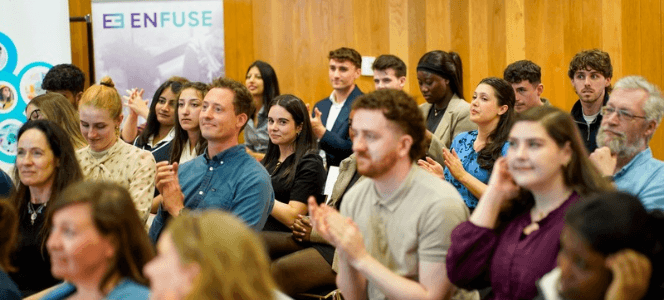
ENFUSE Finals
The collaborative process takes about four meetings, online or in person, from February to April. The team presents a tailored plan in spring, with the strongest projects going to the ENFUSE Finals in May. The last round involved 462 students and 74 enterprises.
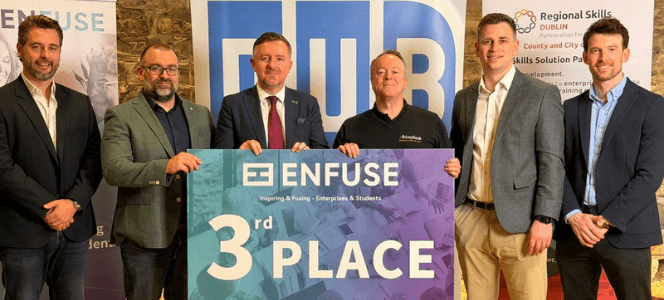
To see what that collaboration looks like in practice, we spoke with three standout finalists: a South Dublin industrial manufacturer, a Ballymun social enterprise salon, and an all-island sustainable fibre network.
Three Standout Stories from the ENFUSE Finals
Fibreshed Ireland: Turning A Challenge into Positive Change
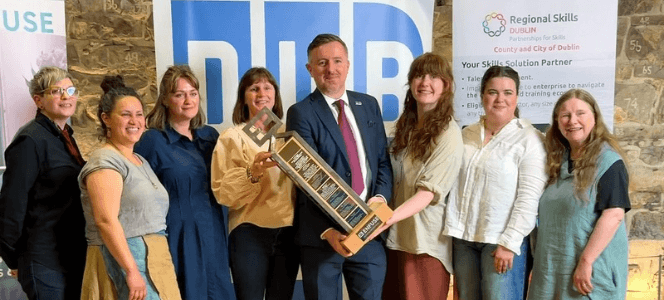
Fibreshed Ireland
Fibreshed is an all-island network of fibre farmers, makers, retailers, and consumers. They were receiving emails from young designers asking where to buy sustainable, Irish-grown fibre.
The thing is that Irish-grown fibre is not currently processed commercially on the island. “We had to sadly tell them that their idea was not viable because the materials they planned to use were not available.” – Malú Colorín, founder and director of Fibreshed Ireland.