Teatime Talks: ‘From ‘Mud Huts’ to ‘Garden Suburbs’: Workers’ Housing in the Docklands’ with Joe Mooney

This event has ended

Online, Wednesday 24th February

Teatime Talks is a series of talks inspired by the history, people and surroundings of 14 Henrietta Street. By listening and engaging with historians, experts, former tenement residents, local residents and their families, we continue to uncover, record and preserve the history and stories of 14 Henrietta Street and Dublin City. Do you have a memory of Dublin’s tenements or know someone who does? Whatever your connection, we would like to hear from you.

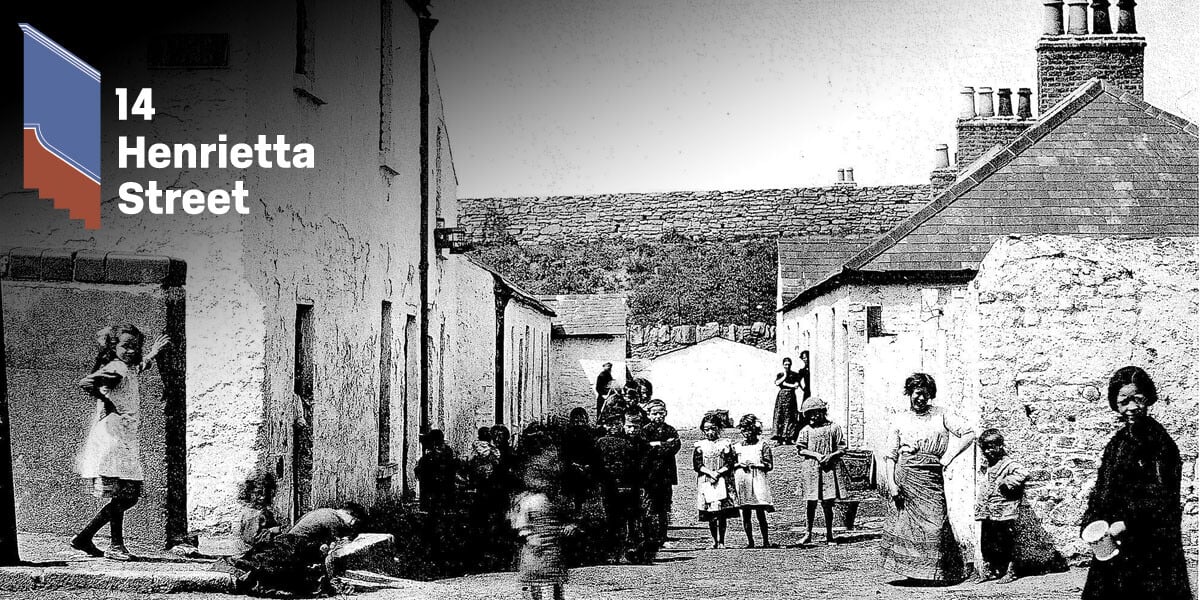
This talk will examine how workers housing in the Dublin docklands evolved, the social, economic and political changes that impacted the workers' lives and homes and what daily life was like for many of those who dwelt here. Dublin’s North Docks were built on reclaimed land. With the expansion of the Port and arrival of the railways in the mid 19th century, a variety of housing types were built for workers and their families. These ranged from ‘traditional’ tenement style housing, employer owned cottages and some described as ‘little better than mud-huts’. Many of the houses were built quickly and were of low quality, with cramped homes squeezed into small streets and alleys. Soon, some of the worst conditions in the city could be found here. In the 20th century, the area would welcome a pioneering Dublin Corporation housing estate with innovative flat-blocks, as the de-tenanting of slum housing became a priority for the Free State Government. This talk will examine how these housing schemes evolved, and the changing nature of life and living in the Dublin Docklands.

Joe Mooney is a long time community activist, a member of the East Wall History Group and a coordinator of the annual Sean O’Casey Festival.


Date:
Wednesday 24th February
Time:
7.00pm
Price:
Free

You might also like...

What's on

Irish Famine Exhibition

Stephen's Green Shopping Centre

The Irish Potato Famine was the most catastrophic event in Ireland's turbulent history. It is also regarded as being one of the worst Famines in history (deaths as a proportion to population). The use of the word 'Famine' in this context is controversial, for Ireland at the time was part of the richest Empire in the World (the British Empire). There was sufficient food in the country throughout the 'Famine' years, yet over a million people died from starvation and disease, and millions more were forced to flee. This Exhibition tells the story of what happened during those horrific years. W

What's on

One Dublin One Book

Dublin

Christine Falls by John Banville is the One Dublin One Book choice for 2026, following on from Dublin Written in Our Hearts, an anthology, chosen for 2025. One Dublin One Book aims to encourage everyone in Dublin to read a designated book connected with the capital city during the month of April every year. This annual project is a Dublin City Council initiative, led by Dublin City Libraries and Dublin UNESCO City of Literature, which encourages reading for pleasure. The author introduces us to the maverick pathologist Quirke whose only passion is finding truth in science. While readers

What's on

Manuals of Immorality: Censoring publications in twentieth-century Ireland

Wood Quay Venue

The scale and ambition of the Irish censorship regime is preserved in a blacklist of over 12,000 publications. From 1930 to 2016, the censorship board banned all manner of printed material. Sex education manuals, pulp fiction, nineteenth-century pornography, celebrity memoirs, and newspapers and magazines appear alongside literature from the greatest twentieth-century writers. This state censorship emerged from the report of the Committee on Evil Literature (1926), which gathered opinions from churchmen of all persuasions, newsagents, charities, trade unions and civil servants. The moral attit